Wrestling Empire
- 4.3
- Rating
- 5.00M
- Installs
- Free
- Price

 Analysis by App-foxy
My first impression of Wrestling Empire was that it is much less interested in presenting a polished sports broadcast than in dropping me into a strange, unpredictable wrestling world and letting me deal with the consequences. That is its appeal. This is a free sports game from MDickie, rated Teen, and it has the rough, eccentric personality I associate with the developer’s other wrestling titles. If you want a serious simulation with clean menus and carefully choreographed presentation, you may feel lost quickly. If you enjoy wrestling as a messy mixture of matches, personalities, decisions, and sudden disasters, it has far more character than its simple first impression suggests.
The game is available for Android and works on devices running Android 7.1 or later. Its store summary, “Let’s take it outside...”, gives a useful hint about the tone: this is not built around quiet, orderly competition. The short description calls it Wrestling Empire, but the experience is broader than simply choosing a wrestler and winning bouts. I found myself paying attention not only to what happened in the ring, but also to how I reached the next match, how other characters reacted, and whether a situation that looked harmless was about to turn into something completely different.
What to expect before your first match
The most important thing to understand is that this is a wrestling sandbox with sports-game elements, not a conventional arcade wrestling package. The controls and presentation can feel unusual at first, and the game does not always guide you toward the exact action you expect. That roughness is part of the design, but it also means the first few minutes may be more confusing than exciting. I had to stop trying to play it like a standard button-mashing wrestling game and instead learn how its interactions behave.
You May Also Like

 Google Keep - Notes and lists
Google Keep’s Quiet Growth Shows the Appeal of Simpler Notes
As mobile work gets busier, Google Keep keeps winning a simple contest: capture a thought quickly, find it later, and get on with the day.

 Blood Strike: 2.5 Anniversary
Blood Strike’s Loadouts Turn Every Drop Into a Tactical Gamble
A close look at Blood Strike’s custom loadouts: how fast access to signature weapons reshapes its battle royale rhythm, rewards preparation, and narrows the gap between fights.

 Pandora - Music & Podcasts
Pandora’s Music Is Easy to Start, but Harder to Recover
Pandora’s strength is its low-effort path from a seed to a station. Its weak spot is how much confidence it asks you to place in connection, setup, and quiet recovery.

 8 Ball Pool
 Is Built on Rivalries, Rematches, and Routine
A close look at the rivalries, rematches, shared routines, and unanswered safety questions that turn a quick pool match into a persistent mobile community.

 Samsung Music
’s Quiet Strength Is Playing What You Already Own
Its reach comes less from spectacle than from dependable access to a personal library. That simplicity is both the app’s strongest retention engine and its ceiling.

 AccuWeather: Weather Radar
AccuWeather Review: A Quick, Clear Forecast for Everyday Decisions
For everyday plans, the best forecast is the one you can understand quickly. AccuWeather makes rain timing, radar, and local conditions easy to act on, with a few trade-offs.
More From Our News Desk



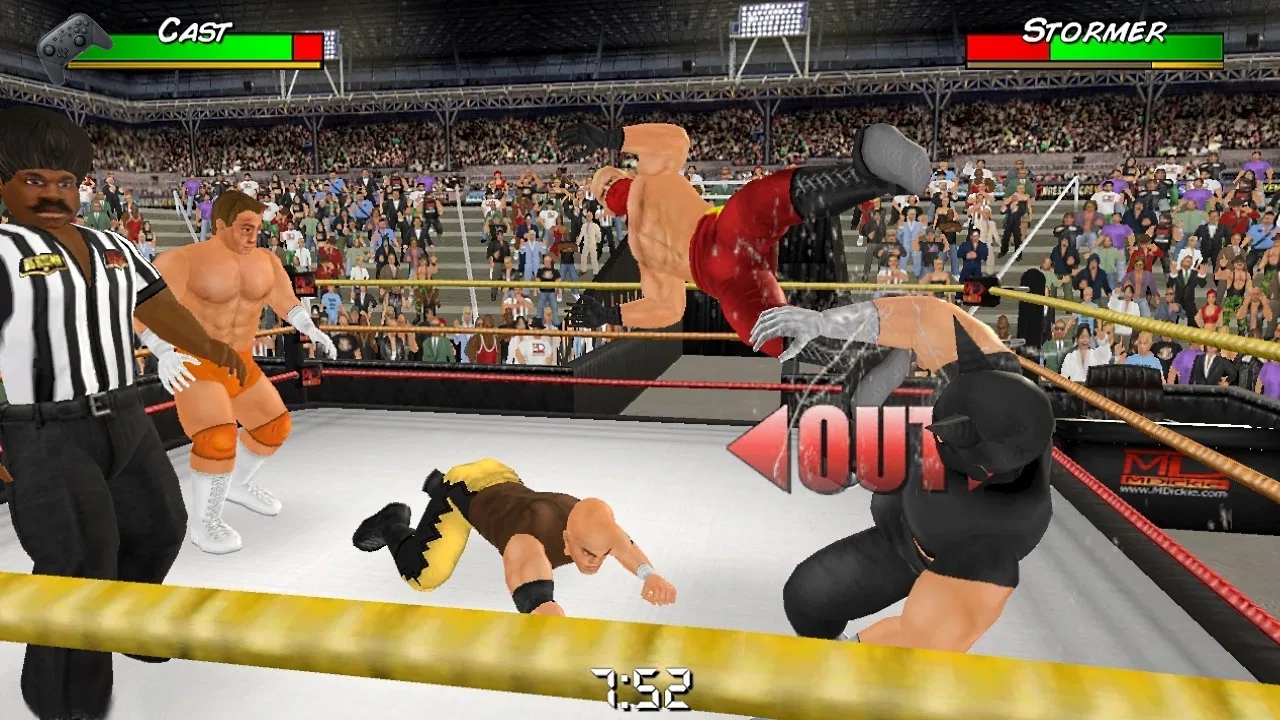
Matches are entertaining because they can become unpredictable. A simple exchange can shift when a character falls, an object becomes involved, or the action moves away from the expected rhythm. I would not describe every moment as elegant. Some collisions look awkward, and the interface can make a basic move feel less immediate than it should. Still, those imperfections often create stories that a more controlled game would never produce.
That makes the game particularly suitable for players who like experimenting. You can approach a match with a clear plan, but you should be ready for that plan to break apart. A player who wants to master a fixed series of combos may prefer a more traditional wrestling title. Someone who enjoys testing what the game allows, recovering from mistakes, and laughing at unexpected outcomes will probably understand the attraction faster.
The game has attracted a large audience, with over five million installs and an average rating of 4.3 from around eighty-four thousand ratings. Those figures suggest that its unusual style connects with many players, although popularity does not remove the learning curve. I would treat the strong reception as a reason to try it, not as a promise that the controls will feel natural immediately.
It is also worth setting expectations about presentation. The visual style is deliberately simple and exaggerated rather than aiming for television realism. Faces, bodies, movement, and environments have a distinctive low-detail look. I think that helps the game remain readable on a wide range of devices, but it can also make the action seem clumsy if you are expecting modern console-style animation. The charm comes from the situations and personalities more than from visual fidelity.
Starting without fighting the interface
After installing the game, I recommend spending the opening session learning movement and basic contact before worrying about long-term progress. The temptation is to rush into every available option, but the controls become easier once you know how your character responds to ordinary movement, attacks, grapples, and recovery. I found that short experiments were more useful than trying to memorize everything at once.
Touch controls require patience because the screen has to communicate several kinds of action without physical buttons. If a move does not happen, I first check whether my character is positioned correctly, whether the opponent is in a suitable state, and whether I am pressing or holding in the intended way. Repeating the same input harder is not always the solution. In this game, context matters as much as the command.
My practical advice for a first session is simple: move around the ring, approach an opponent from different angles, attempt one basic attack, and then try to disengage. This gives you a feel for spacing and timing before the match becomes chaotic. I also suggest keeping your first goal modest. A clean escape from a bad position can be a more useful early success than an ambitious finishing sequence that you cannot reproduce.
The game is free to download, but it includes in-app purchases priced at $3.99 per item. I would not make a purchase during the first session. The best way to decide whether those options are worthwhile is to spend enough time with the basic experience to learn whether you enjoy its unusual controls and sandbox structure. Paying before that point would not solve the central question, which is whether this particular style of wrestling suits you.
The current version is 1.7.9, and the game was released on January 30, 2021. For a first-time user, the more useful point is that you should approach it as an established, content-rich wrestling playground rather than a tiny one-match demo. There is enough going on to reward curiosity, but that also means the game does not always explain its possibilities in a neat, beginner-friendly order.
How I reached the first meaningful success
My first meaningful success was not a spectacular victory. It was completing a match while staying in control of my character instead of reacting randomly to every movement. That distinction matters. Once I stopped chasing dramatic attacks and began watching distance, positioning, and recovery, the game became less frustrating. I could recognize when to press forward and when to create space.
For a new player, I would define the first success in the same way: perform a basic offensive action, survive the opponent’s response, and finish the encounter with a clearer idea of what caused each result. If you win while pressing random controls, you may not learn much. If you lose after making a deliberate choice, you may actually be closer to understanding the game.
One useful habit is to treat the ring as a set of positions rather than a flat background. Being near the ropes, close to another character, or caught in a crowded exchange changes what is practical. I found that many failed actions were not failures of timing alone; they were attempts made from an unsuitable place. Moving first and attacking second made my actions more reliable.
Another helpful habit is to avoid using the strongest-looking action every time it becomes available. Big moves are satisfying, but they can leave you exposed or place you in an awkward position. Basic attacks and controlled movement often create a better opening. This is one of the game’s less obvious trade-offs: flashy play looks effective, but patient play is easier to repeat.
When I finally completed a match with that approach, the game’s appeal became clearer. It rewards attention without becoming a strict technical simulator. I was not following a perfect tournament plan; I was managing a living, unpredictable situation. That is the kind of success a first-time player should aim for before exploring more complicated scenarios.
Why the action can feel confusing
The biggest source of confusion is that the game does not always separate actions as clearly as a highly polished sports title would. Wrestling involves contact, movement, objects, falls, and changing positions, so the same input can feel different depending on what is happening around the character. I initially interpreted that inconsistency as a control problem. Later, I realized that I was often ignoring the situation around the input.
If a grapple fails, check whether the opponent is too far away, already occupied, or moving in a way that changes the interaction. If a character does not recover as expected, give the scene a moment instead of immediately repeating commands. If the camera or crowd makes the action hard to read, repositioning can be more effective than continuing to attack. These small adjustments save a surprising amount of frustration.
The game’s humor can also disguise useful information. Characters may behave in exaggerated ways, and a scene can become absurd very quickly. It is easy to treat everything as a joke and miss the practical lesson. I learned to enjoy the chaos while still asking what caused it. Did I enter a crowded area? Did I leave myself open? Did I choose an action that required more space? That mindset turns confusion into experimentation.
Another common mistake is assuming that a wrestling game should be played entirely inside the ring. The title’s “Let’s take it outside...” summary points toward a broader attitude, and the game often feels most distinctive when the action stops following a tidy match structure. I would not recommend forcing every situation back into a formal exchange. Sometimes the better approach is to observe what the environment and other characters are doing before deciding whether to engage.
That freedom is also a limitation. Players who want a predictable ruleset may find the game irritating, especially when an encounter becomes difficult to read. It is not the best choice for someone looking for a calm, precise sports routine after work. A more conventional wrestling game will usually offer clearer combos, more obvious match flow, and a smoother path from selection screen to victory.
Turning short sessions into a useful routine
For an everyday scenario, imagine having ten minutes while waiting for an appointment. I would not begin by trying to build a perfect career or understand every system. I would choose a match, focus on one control objective, and use the session to practice positioning. If the action becomes chaotic, I would treat it as part of the entertainment rather than a failed training exercise. That makes the game work well in short bursts, provided you are comfortable with sessions that do not always end neatly.
For a longer evening, I would play differently. I would begin with a simple match to warm up, then explore the surrounding wrestling world and see how the next situation develops. The appeal of the longer session is not just repetition; it is seeing how one decision can lead to a stranger opportunity or a more difficult confrontation. The game is at its best when I allow room for those unexpected turns.
A concrete workflow helped me avoid burnout. First, I played until I understood one reliable attack. Next, I practiced escaping from trouble instead of always trying to reverse it. Finally, I tested one riskier action only after I had a safe way to recover. This sequence made progress feel earned and reduced the temptation to blame the controls for every mistake.
I also recommend using the game as a story generator rather than judging every session by its win record. A match where everything goes wrong can still be memorable if it produces a surprising rivalry, an accidental escape, or a ridiculous sequence of events. That perspective is not for everyone, but it is central to why this game stands apart from more orderly wrestling alternatives.
Who should install it and who should skip it
I would recommend it to wrestling fans who enjoy personality, unpredictability, and systems that interact in messy ways. It is especially appealing if you like discovering unusual outcomes instead of following a carefully scripted presentation. Players who enjoy MDickie’s distinctive style will likely settle in faster because the rough edges feel intentional rather than unfamiliar.
I would be more cautious recommending it to someone buying a phone game for realistic sports presentation. The visuals are not the main attraction, and the controls take work. It is also not my first choice for a young child, since the content rating is Teen and the action can be aggressive and chaotic. For a player who wants a clean, instantly understandable experience, a more conventional arcade wrestling game would be easier to recommend.
The free entry point is useful because it lets you test the central experience without committing money first. I would keep the in-app purchases in perspective: at $3.99 each, they are not an enormous barrier, but they are still unnecessary until you know the base game holds your attention. The purchase decision should come after you have learned whether the unusual structure feels entertaining or merely awkward.
Compared with a standard sports game, this one gives up polish for freedom. Compared with a traditional wrestling game, it gives up some clarity for surprise. Compared with a simple arcade brawler, it offers more context and personality, but it also asks you to tolerate more friction. That trade-off explains both its devoted audience and the divided reactions a new player may have during the first hour.
The next step after the first win
Once I had a basic understanding of movement and contact, I stopped trying to master everything and chose one area to improve at a time. I worked on starting exchanges, then on surviving them, and only afterward on creating more dramatic moments. This approach is particularly useful here because the game can present several distractions at once. A narrow goal keeps the experience readable.
I would also encourage new players to replay situations rather than immediately abandoning the game after an awkward loss. The same kind of encounter can teach you more on a second attempt because you already know what confused you. Try changing one decision: approach from a different angle, wait before attacking, or move away from a crowded area. Small changes reveal which parts of the result were under your control.
My honest view is that Wrestling Empire is not a universally smooth recommendation, but it is a memorable one. Its rough presentation, unpredictable action, and unusual learning curve can be obstacles, yet they are also the reason it does not feel like another interchangeable wrestling app. I kept playing because the game made me curious about what would happen next, not because every match was perfectly executed.
MDickie has created a sports game for players who are willing to meet it halfway. Give it time to explain itself through play, start with manageable goals, and do not confuse chaos with failure. If you want a polished simulation, choose something more controlled. If you want a free Teen-rated wrestling sandbox where a straightforward match can turn into an unexpected story, this is worth installing on a compatible Android device.
In the end, my recommendation is simple: begin with the basic experience, postpone the $3.99 purchases, and judge the game after you have learned how positioning affects your actions. The first successful match may feel modest, but it is the point where the controls start making sense. From there, the game’s strange personality becomes its strongest feature, and the decision to keep playing feels much more natural.
FAQs for Wrestling Empire
01What platforms is Wrestling Empire available on?
Wrestling Empire is available on both Android and iOS platforms. Users can download it from the Google Play Store or the Apple App Store. The game is designed to run smoothly on a variety of devices, ensuring an engaging experience regardless of whether you’re using a phone or tablet.
02Does Wrestling Empire require an internet connection to play?
Wrestling Empire is primarily an offline game, allowing you to enjoy wrestling matches without needing an internet connection. However, certain features, such as updates or online multiplayer modes, may require connectivity. This makes it convenient for users who want to play on the go without relying on Wi-Fi or data.
03Are there in-app purchases in Wrestling Empire?
Yes, Wrestling Empire includes in-app purchases. While the game is free to download, players can purchase additional content or features to enhance their experience. These purchases are optional, and players can still enjoy the core gameplay without spending money. It’s a great way to support the developers if you choose.
04Is Wrestling Empire suitable for all age groups?
Wrestling Empire is generally suitable for a wide range of age groups, but it is important to note that it includes wrestling content that might not be appropriate for very young children. Parents are encouraged to review the game’s content and settings to ensure it aligns with their family’s standards before allowing younger players to engage.
05How customizable are the characters in Wrestling Empire?
Wrestling Empire offers extensive customization options for characters. Players can modify their wrestler’s appearance, moves, and even their entrance style. This level of customization adds depth to the gameplay, allowing players to create unique wrestlers that reflect their personal style and preferences, enhancing the overall gaming experience.
Pros
- Immersive career mode with rich storylines.
- Customizable characters and arenas.
- Dynamic
- physics-based gameplay.
- Offline play available without internet.
- Regular updates with new features.
Cons
- Graphics can appear outdated at times.
- Occasional bugs disrupt gameplay.
- Limited soundtracks and audio variety.
- Controls can feel clunky on small screens.
- In-app purchases can be expensive.

Wrestling Empire
Gallery